Almost every conversational AI platform is built on one assumption: one company, one account, one set of bots. The assumption is invisible while you evaluate the product and expensive the first month you run three hundred agents on it.
Two problems get filed under that number, and only one of them is hard. Three hundred agents inside one undivided company is capacity: more traffic, more definitions, more logs, and you buy your way out of it on a Tuesday. Three hundred agents across twenty organisations that must not see each other's data is isolation, and isolation is the one thing you cannot add on a Tuesday. If it was not in the data model on day one, it is a migration.
Everything below is about the second one. It is worth being precise about who has it, because the obvious answer is only half.
- You sell agents. A reseller, an IT integrator, a software factory: twenty client companies, each wanting their own branding, their own data and their own auditor's answer.
- You are the company. A multinational with fifteen business units, a holding with eight subsidiaries, a state with nine ministries. Nobody is buying anything from anybody, and every boundary from the first case is still there — legal is not allowed to read HR's conversations, each unit's budget has to be attributable, and one region's data cannot leave it.
The second case is usually discovered later and hurts more, because the platform was chosen when the pilot had one agent and one team. In both, you are not managing a company. You are operating a fleet.
What follows is what "multi-tenant" has to mean structurally before the label is worth anything, and five questions that separate a vendor who built it from a vendor who added a customer_id column.
Both directions arrive at the same architecture
The fleet problem looks like a specialist's problem today. It will not stay one.
In an April 2026 press release, Gartner projected that the average global Fortune 500 company will be running more than 150,000 agents by 2028, up from fewer than 15 in 2025. In the same release: 13% of organisations believe they have the right agent governance in place. Gartner's term for the gap between those two numbers is agent sprawl, and its senior director analyst Max Goss frames the work as governing the fleet without blocking the people building it.
McKinsey arrives at the same place from a different direction. Its 2026 read on AI trust puts roughly a third of organisations at a governance maturity adequate for the autonomous agents they are already running.
Read that as an architectural signal rather than a scare statistic. A hundred and fifty thousand agents will not sit in one undivided pool: they will sit in divisions, regions and functions that cannot read each other, which is the same drawing as twenty client companies with a different label on the boxes. Whoever sells agents for a living meets that drawing three years early, at a size where it is still cheap to change. Whoever runs a large organisation meets it once the pilot ends, at a size where it is not.
The part that does not show up in a trial
Say you run agents for twenty organisations on a per-account platform — twenty clients, or twenty business units, the arithmetic is identical. The subscription total is the obvious cost and the least interesting one. What follows it:
- Twenty logins. Nobody on your team has a single view of anything.
- Twenty billing relationships, each renewing on its own date, each with a plan ceiling you hit on a different Tuesday.
- Twenty copies of the same configuration. You built one good lead-qualification flow. It now exists in twenty places and drifts in twenty directions.
- Twenty credential sets. Every model key, every CRM token, every messaging number is configured, rotated and audited separately.
- No aggregate anything. "What did we spend on inference last month, across every client?" is a spreadsheet afternoon.
None of that shows up in a fourteen-day trial. All of it shows up in month six.
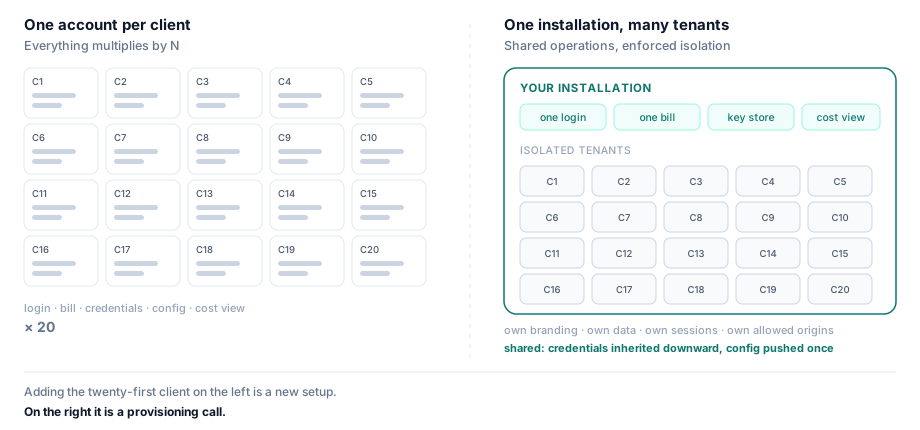
The asymmetry in that picture is the entire argument. On the left, the twenty-first client is a new setup. On the right, it is a provisioning call.
Five boundaries, and four of them is zero
Multi-tenancy is not a pricing tier and it is not a column. It is a property of the data model: one installation serves many organisations, and the boundaries hold underneath the application rather than because everyone remembered to add a filter.
There are five. A platform that enforces four has effectively enforced none, because the one it missed is the one that will leak.
| Boundary | What it must guarantee | Where it is usually lost |
|---|---|---|
| Data | No query path returns another tenant's rows — agents, workflows, knowledge bases, documents, tools, history, metrics, connections | A filter applied in the service layer instead of the repository. One forgotten where and the boundary is gone with no error raised |
| Credentials | Client A's model key is unreachable from client B's runtime | Shared environment variables, or keys stored on the workflow definition rather than in a tenant-scoped secret store |
| Sessions | Conversations never bleed, including across channels | Session keys built from user identity alone, so the same person's messaging thread inherits the state of their web chat |
| Origins | Another site cannot post to your client's agent endpoint | CORS configured per deployment instead of per tenant |
| Memory | Long-term facts extracted for one client stay there | Memory bolted on later as a global store, after tenant scoping was designed |
The channel line is the one worth pausing on, because it is where correctness and privacy meet. A session key of (tenant, agent, channel, external_user) behaves differently from (user) in exactly the case that matters: the same human talking to the same brand on two surfaces. If the platform cannot tell those apart, "multi-tenant" was never the first thing it got wrong.
The data line deserves the same scrutiny, and it is the harder one to verify from the outside. Tenant scoping enforced at the repository — where every method takes the tenant as a required parameter rather than an optional filter — fails loudly when someone forgets. Tenant scoping enforced by convention in the service layer fails silently, in production, in front of a client, roughly eighteen months in.
Isolation without inheritance is twenty installations in a trench coat
Isolation alone gives you twenty sealed boxes, which is half the problem. The other half is that you do not want to configure the same thing twenty times.
The structure that solves it is a tenant hierarchy: you are the parent tenant, your clients are tenants beneath you, and configuration flows downward. A parent registers its model connections once; children resolve them up the tree, and cannot modify what they inherited. That read-only property is what makes it safe rather than merely convenient — the client's team can operate their agents without being able to read, rotate or export a credential you are paying for.
The general form of the rule: inherit downward, override locally, never mutate upward. Branding, limits, connections and guardrail policy all want the same treatment. Anything the operator must be able to change once and have take effect everywhere belongs at the top of the tree; anything a client legitimately owns belongs at their level as an override.
What the architecture buys upstream
These are engineering decisions with commercial consequences, which is the part that usually goes unsaid in architecture write-ups.
White-labelling stops being a favour. When branding is a per-tenant property, each surface carries the identity that belongs to it — the client's brand, or the subsidiary's — rather than yours or the vendor's. That is the difference between delivering a platform and reselling one with a logo taped on.
Marginal cost stops tracking the org chart. Per-account pricing grows linearly with tenants by construction. One installation amortises across all of them, and the cost of the twenty-first trends toward inference plus support.
Residency becomes answerable. A healthcare or finance client will ask where the conversations live. If the answer depends on a vendor's region list, you are negotiating. If you control the deployment, you are answering.
Exit risk becomes yours to price. A platform you can deploy is a platform you can keep deploying. That is a materially different conversation with a procurement team than "we depend on this SaaS."
When not to do this
A managed single-tenant product is less work on day one. Somebody else patches it, scales it and gets paged at 3am. If you serve one or two clients and expect that to hold, per-account is the right call — running a platform has an operational cost that does not go to zero because the architecture is better.
Nesting is not free either. Tenant-per-client means a boundary to provision, permissions to model and a hierarchy to reason about. Plenty of operators are better served by agent-per-client inside a single tenant, sharing one credential set they control. The dividing question is not scale, it is ownership: choose tenant-per-client when the client needs a boundary — their own login, their own isolated data, their own auditor asking where things live. Choose agent-per-client when what they need is a bot.
The crossover arrives earlier than most operators plan for. We have watched account sprawl overtake platform-operation cost somewhere around the fifth or sixth client — an observation across deployments, not a law, and it moves with how similar your clients' configurations are. Twenty near-identical flows and sprawl bites sooner. Twenty bespoke ones and it bites later.
Five questions to ask any vendor
Take these to the next evaluation. Each is answerable in a sentence by someone who built it, and each produces a visible pause in someone who did not.
- "With twenty clients, how many logins does my team need?" Any answer containing "twenty" ends the evaluation.
- "Can a client's team operate their agent without being able to read or export my provider key?" Tests read-only credential inheritance specifically, not credential storage in general.
- "I want to move every agent across every client to a different model. Walk me through it." Listen for whether the number of steps depends on the number of agents.
- "Does the same end user's messaging conversation share state with their web chat?" Tests whether session identity includes the channel.
- "Where does the data live, and can I run this myself if I have to?" Residency and exit risk in one move.
The useful question when evaluating an agent platform is no longer "can it build a good agent?" Most of them can now. It is what happens on the day you have twenty — and if the answer involves twenty of anything, you are looking at a tool built for a company rather than a platform built for an operator.
Gartner's Fortune 500 is three years from asking that question about six figures of agents. The shape of the answer does not change with the number.